
CDCR State Release Records
CDCR CIRIS stands for California Incarcerated Records and Information Search. The CA.gov service page says CIRIS results include name, CDCR number, age, current location, commitment counties, admission date, and Board of Parole Hearing dates and outcomes for incarcerated persons currently in CDCR custody. For Tulare County released-inmate research, that means CIRIS applies only when the person moved from local case processing into California state-prison custody or a state parole framework.
Many people who leave Adult Pre-Trial, Bob Wiley, or South County never go to CDCR. They may be released on bond, time served, dismissal, probation, or a local sentence. CDCR becomes relevant when the Tulare Superior Court sentence sends the person to state prison, when parole or PRCS follows prison, or when a parole hearing is part of release consideration. A no-result CIRIS search does not disprove a Tulare County jail release. It may simply mean the custody event was local.
| CIRIS field | Use in Tulare County release research |
|---|---|
| CDCR number | Strongest state-prison identifier when known |
| Commitment county | May connect the state record to a Tulare County case |
| Admission date | Shows when state custody began after county transfer |
| Current location | Shows state custody status when listed |
| BPH dates and outcomes | Points to parole suitability or hearing history |
Search CDCR from Tulare
Use CIRIS after a court record, county release field, or family notice indicates a state-prison commitment. Search by CDCR number if known. If not, use the full legal name and compare age, location, and commitment county. For a Tulare County conviction, commitment county can be an important cross-check because name-only state searches can produce false matches.
- Check Tulare County court records for the sentence, abstract of judgment, or prison commitment.
- Open CDCR CIRIS and search by CDCR number or name.
- Compare commitment county, age, admission date, and current location before relying on a match.
- Review any BPH dates or outcomes, then use the BPH page when parole-hearing context is needed.
- Return to Tulare sheriff records if the question is the county time and manner of release to CDCR.
A county-to-state transfer can make two records true at once. Tulare County may show release from sheriff custody or current holding location. CDCR may later show state admission and location. The court abstract connects the two. The Release Date Lookup page covers California credit and release-date labels in more detail.
CDCR Release Date Labels
California state release dates should use official labels rather than generic promises. BPH identifies EPRD, MEPD, NPED, YPED, and EPED as release or parole-eligibility date concepts. EPRD is tied to determinate sentences and credits. MEPD is tied to indeterminate parole consideration. NPED, YPED, and EPED come from specific eligibility tracks. These labels can change through credits, forfeitures, court corrections, BPH action, holds, or transfer issues.
- EPRD
- Earliest Possible Release Date for determinate sentences, based on the court term less credits.
- MEPD
- Minimum Eligible Parole Date for indeterminate or lifer parole consideration.
- NPED
- Nonviolent Parole Eligible Date under Proposition 57 rules.
- YPED
- Youth Parole Eligible Date for qualifying age-at-offense cases.
- EPED
- Elderly Parole Eligible Date for qualifying older incarcerated people.
California Penal Code 2900.5 and 4019 govern county custody credits; Penal Code 2933 and 2933.1 govern key state-prison credit issues, including the practical 85-percent rule for listed violent felonies. Those statutes affect the date, but the public lookup still depends on official CDCR and court records.
CIRIS is a state-prison search. Use Tulare County sheriff and court records for ordinary county jail release confirmation.
CIRIS Search Source
The CDCR CIRIS search is the official state-prison lookup route for California state custody records.
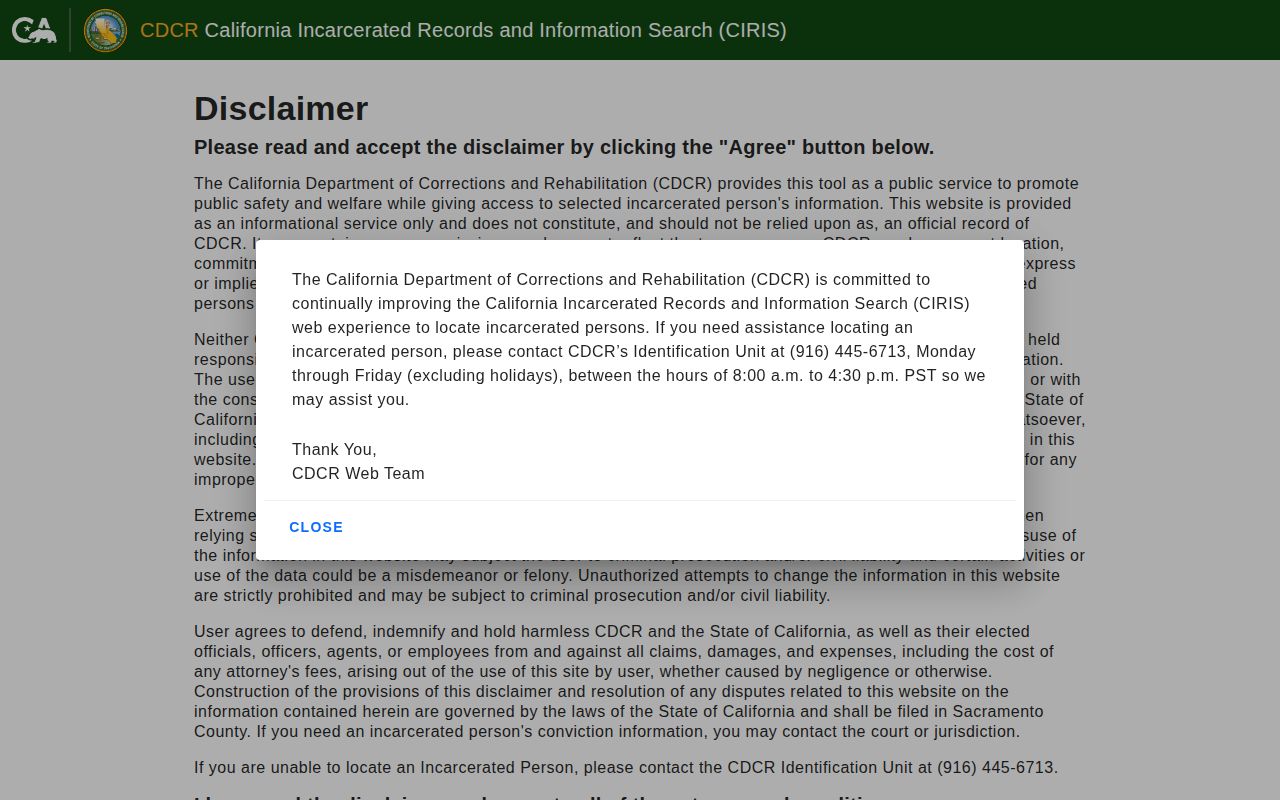
Use CIRIS only after the facts point to state custody. For county jail release, use Tulare sheriff, VINE, and court records instead.
CDCR Records Contact
The CA.gov CIRIS service page lists CDCR Identification Unit phone 916-445-6713. That is a state contact, not a Tulare County jail phone. If the needed state-prison record is not available through CIRIS, use official CDCR records channels. If the issue is the county jail release to CDCR, ask Tulare sheriff records for the release or transfer field and Tulare Superior Court for the abstract or sentencing order.
CDCR CIRIS
ciris.mt.cdcr.ca.gov
CDCR Identification Unit: 916-445-6713
County bridge records
Tulare Superior Court sentencing record
Tulare sheriff release or transfer record
Note: A person can be released from Tulare County sheriff custody to CDCR and still remain in state custody.
Tulare County to CDCR
The county-to-state bridge usually starts in court. A Tulare Superior Court sentence, abstract of judgment, and credit calculation explain why the person left county custody for state prison. The sheriff record can show the time and manner of release from the jail or the receiving custody location. CIRIS can then show the state side, such as CDCR number, admission date, commitment county, and current location if the person is in state custody.
This bridge prevents a common error. A person may be released from Adult Pre-Trial, Bob Wiley, or South County because the county facility no longer holds them, but the same person may be admitted to CDCR. In that scenario, the county release is not a final community release. It is a custody transfer into the state prison system.
If the person later reaches parole, PRCS, or discharge, the search path changes again. BPH may explain hearing results for parole-eligible cases. Tulare County Probation may be the local path for PRCS. CDCR parole or DAPO may matter for state parole. Keep those terms separate from county probation and from the original jail booking.
When CIRIS lists Tulare as a commitment county, use that as a match point rather than as the whole story. The court sentence explains the judgment, the sheriff record explains county release or transfer, and the CDCR record explains state custody. A careful release search keeps all three records in order.
That order is especially useful when a family sees a county release notice before the CDCR record updates.