
Projected Versus Actual Release
A projected release date is the best available scheduled or calculated date before release. An actual release is the custody event that has already occurred. In Tulare County jail cases, the sheriff's current-custody search can tell you whether someone is listed now, but the researched pages do not publish a public projected-release calculator. For a county sentence, the court's custody-credit calculation and jail records matter. For a state-prison sentence, CDCR and BPH terminology matters.
Pretrial detainees usually do not have a computed release date. Their release depends on bail, own-recognizance release, dismissal, court order, warrant or hold status, transfer, sentence credit, or another agency taking custody.
How to Find the Date
- Identify the custody system: Tulare county jail, CDCR state prison, BOP federal custody, ICE custody, or a court-supervision program.
- For county jail, check the Tulare active inmate search for current custody and the Superior Court case for bail, sentencing, custody credits, dismissal, or release order.
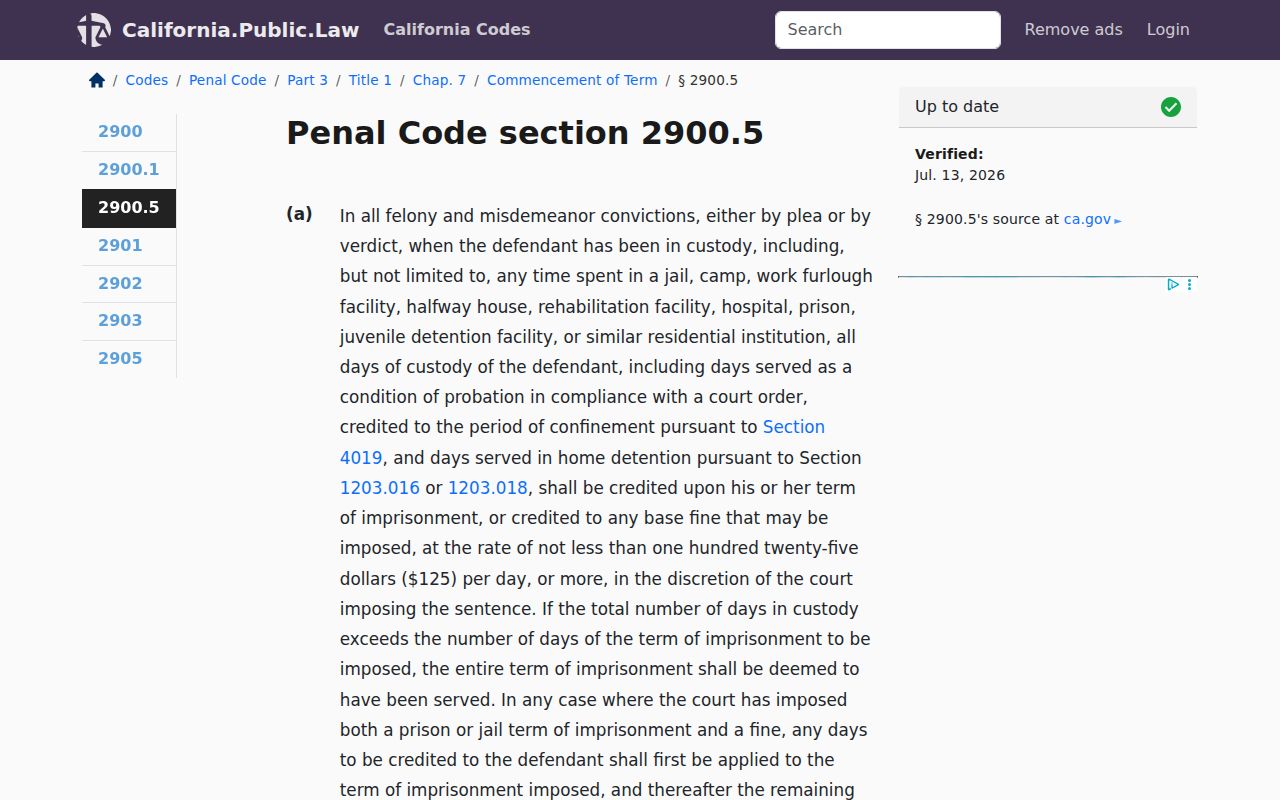
- For a county sentence, request or review the court minute order and credit calculation under Penal Code 2900.5 and 4019.
- For state prison, search California CDCR / CIRIS and look for official CDCR or BPH date labels.
- For parole-hearing cases, check California Board of Parole Hearings schedules, results, and eligibility material.
- Use VINE Inmate Check for custody-change notifications and confirm actual release through the responsible agency.
- If the date must be documented, ask Tulare Sheriff Records for the time and manner of release or current holding location for the specific booking.
California Credit Rules
California Penal Code 2900.5 governs custody credits and requires the sentencing court to determine custody admission and release dates and total credits for the abstract of judgment. It also says that if qualifying custody days exceed the term to be imposed, the term is deemed served. Penal Code 4019 governs local conduct credits for county jail and related local custody settings, with the researched language explaining that, where all days are earned, four days are deemed served for every two days actually spent in custody, subject to statutory limits.
For state prison, Penal Code 2933 covers CDCR worktime credit reductions for eligible continuous incarceration and says credits can be forfeited. Penal Code 2933.1 is the major California 15-percent cap for listed violent felonies, creating the practical 85-percent rule. These statutes explain why two people with similar sentence lengths can have different projected dates.
CDCR and BPH Date Labels
BPH identifies several official release and parole-eligibility labels. EPRD is the Earliest Possible Release Date for determinately sentenced offenders after applicable credits. MEPD is the Minimum Eligible Parole Date for indeterminately sentenced offenders. NPED is the Nonviolent Parole Eligible Date under Proposition 57 after the full term of the primary offense, excluding sex offenders. YPED is Youth Parole Eligible Date for qualifying people who committed the controlling offense under age 26 and have served the required period. EPED is Elderly Parole Eligible Date.
Those labels belong to state-prison research, not ordinary Tulare County jail bookings. A Tulare defendant sentenced to CDCR may leave county custody by transfer and later appear in CIRIS or BPH materials. That transfer is a county release event, but it is not necessarily a final release from custody.
Why a Release Date Changes
| Change factor | Effect on release date |
|---|---|
| Credits earned, denied, forfeited, or restored | Can move a projected date earlier or later depending on the statute and custody system. |
| Court correction or new minute order | Can change custody credits, sentence length, release authority, or abstract of judgment details. |
| Warrant, hold, detainer, or another agency | Can prevent physical release or change release into transfer. |
| BPH outcome | A grant, denial, continuance, postponement, waiver, stipulation, or cancellation affects parole-hearing cases differently. |
| Federal recalculation | BOP warns that federal release dates may change as sentences are reviewed for Federal Time Credit changes. |
| ICE transfer | A county jail release may become immigration custody rather than community release. |
Confirm the Actual Release
When the date arrives, confirm actual custody status through the system that controls the person. For Tulare county jail, use the sheriff active search, VINE, facility contact, court records, and Sheriff's Records. For CDCR, use CIRIS, BPH if relevant, and parole or PRCS routing. For federal custody, use BOP. For immigration detention, use ICE when the facts point there.
For a formal Tulare County release record, ask for time and manner of release or current holding location. That language comes from California public-records law and keeps the request focused on the release event rather than a broad local criminal-history file.
Court Records Explain the Date
Tulare Superior Court records often explain why a release date exists or why it changed. The court online services page says the Case Index Search can show case summaries, filings, party information, and more, and the online portal requires login for case search. The records-request page says users can start with the public Case Index Search Portal if the case number is unknown. For release-date research, the useful court documents are minute orders, sentencing orders, custody-credit calculations, warrant recall entries, probation grants, PRCS revocation orders, and abstracts of judgment.
The Adult Pre-Trial Facility is also listed by the court as an in-custody hearing location, which means a Tulare release can follow an arraignment, bail decision, OR release, dismissal, sentence-credit decision, or transfer order. South County cases may involve the South County Justice Center in Porterville. If the date question is local rather than CDCR, a court minute order may be more informative than a roster search because it gives the legal reason custody should end.
No County Calculator Found
The researched Tulare County pages did not identify a public jail release-date calculator. That absence matters because local jail time can turn on facts that a calculator would not know: exact admission and release dates, presentence credits, conduct credits, sentence type, court corrections, holds, other-agency custody, and whether a person is serving a local term or awaiting court. For a sentenced local case, combine the court order with jail records. For a state-prison case, use CDCR and BPH date labels instead of trying to apply a county-jail estimate.
When uncertainty remains, avoid treating a projected date as a promise. Ask the responsible agency what the current calculation shows and whether any warrant, hold, detainer, transport, disciplinary credit issue, or pending court order could prevent release on that date.
Examples by Custody System
A Tulare County pretrial detainee may have no release date at all. The practical question is whether bail was posted, the court ordered release, the case was dismissed, a warrant was recalled, or another hold remains. For that situation, the court and jail are the controlling sources. A person serving a local county jail term may have a computed end date, but the calculation depends on custody credits, conduct credits, actual days, and any disqualifying facts in the statutes. For that situation, compare the sentencing order, credit calculation, and jail record.
A Tulare defendant sentenced to state prison moves into a different date system. CDCR and BPH use labels such as EPRD and MEPD, and those labels are not the same as a county jail release estimate. A BPH hearing can also affect the timeline, but a result must be interpreted carefully. "Grant" means a suitability recommendation subject to further review, while postponed, continued, waived, or stipulated outcomes do not mean the person has left custody. A cancellation can happen for several reasons and should not be treated as release without confirmation.
Federal and immigration paths are separate again. BOP records cover federal inmates from 1982 forward, and BOP explains that a past release date with no facility location means the person is no longer in BOP custody, though another system may still apply. ICE custody can follow a county jail release if an immigration detainer or transfer is involved. In those cases, "released from Tulare County custody" is not the same as "released from all custody."
The same caution applies to jail alternatives. The Tulare County Day Reporting Center and Sheriff's Work Alternative Program are not release-date calculators, but they can matter when a sentence is served or completed through an alternatives-to-custody path. Verify completion through the court, supervising program, sheriff records, or probation as appropriate. If the person is physically out of jail but still under a court-ordered program, the release-date question has shifted from custody status to compliance and completion status.
For every system, save the source and date checked. A projected CDCR date, a VINE status, a court minute, and a sheriff records response may be created at different times. If the records appear inconsistent, the newest official agency record is not automatically the most complete one. Compare them by role: custody status, legal authority, credit calculation, supervision, and transfer destination.