
Juvenile Release Path
Tulare County Juvenile Detention Facility and the Juvenile Justice Center are separate from the county's adult released-inmate search paths. The Probation Department lists the juvenile detention facility at Avenue 368 in Visalia, and the Superior Court maintains a juvenile division. Those sources point to a controlled juvenile process rather than a public adult jail list. A juvenile release may involve probation direction, a juvenile court order, counsel, parent or guardian notice, placement, return home, or another court-authorized outcome.
The central rule is simple: do not use adult jail absence as a juvenile release conclusion. A minor may not appear in adult custody tools because the matter is juvenile, confidential, sealed from general public access, or handled through probation and court channels. Public adult terms like roster, booking-photo release, and recent-release list can mislead readers when the person is a juvenile.
- Juvenile detention
- A youth custody setting tied to juvenile court and probation, not a public adult jail roster.
- Authorized party
- A person or office allowed by court rules or order to receive juvenile case or custody information.
- Release order
- The juvenile court or probation action that controls whether and how the youth leaves detention.
Juvenile Facility Contacts
The Probation Department and court sources are the key contacts for juvenile matters. The Probation contact page lists the juvenile detention facility phone, and the Superior Court juvenile division page gives the court context. Use those sources before trying adult release-list pages.
Tulare County Juvenile Detention Facility
11200 Avenue 368
Visalia, CA 93291
Phone: (559) 735-1600
Tulare County Probation Department
3241 W. Noble Ave.
Visalia, CA 93277
Phone: (559) 608-9035
Tulare Superior Court Juvenile Division
Use the court's juvenile division and authorized records process for case access.
For adult county jail release records, use the adult facility pages and the main Tulare County released inmates page. For a juvenile matter, avoid adult mugshot and recent-release assumptions unless an official source confirms the person is in an adult custody system.
Juvenile Probation Source
The Tulare County Probation contact page is the local source for the juvenile detention facility listing and probation contact route.

That contact route matters because juvenile release information is tied to probation and court authority, not a public adult release feed.
The Tulare Superior Court juvenile division page is the companion court source for juvenile case context.
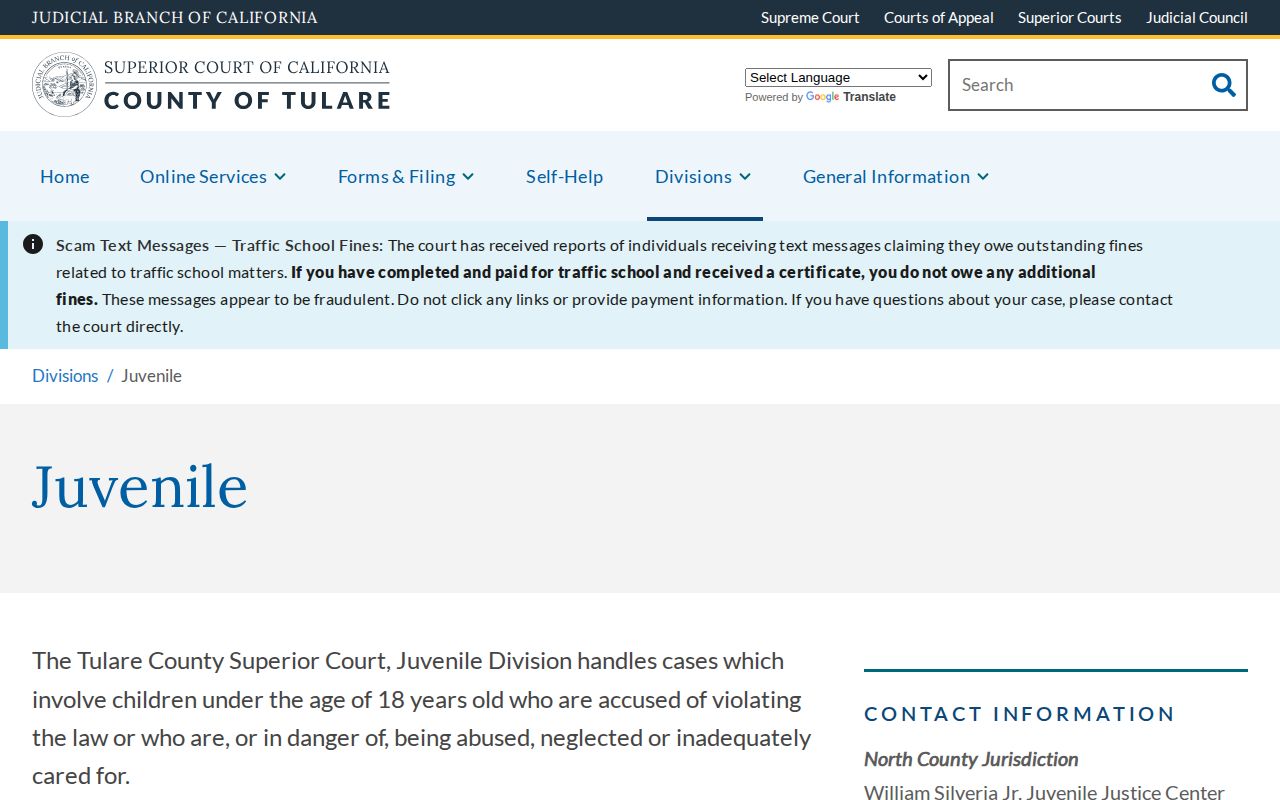
Pairing probation and court sources helps distinguish lawful juvenile case access from adult custody-search habits.
Adult Tools Do Not Fit
Tulare County's adult current-custody search, VINE jail notices, adult facility booking-sergeant contacts, and adult records request route are useful for adult custody. They are not the default juvenile release path. The juvenile facility page exists to prevent a common mistake: using adult public jail records to infer juvenile custody, release, or case outcome.
- Identify whether the case is juvenile or adult.
- Use probation or juvenile court if it is a juvenile matter.
- Use counsel or a court-authorized records request when records are needed.
- Use adult sheriff custody tools only if an adult custody event is confirmed.
Note: Juvenile release confirmation depends on legal access, so public adult jail search gaps should not be read as case facts.
Juvenile Family Release Route
For a family member, the useful first step is to identify the assigned probation or court contact rather than searching public adult jail pages. Juvenile detention is tied to a youth case, a parent or guardian notice process, counsel, and court orders. A public web search may show little or nothing even when a real custody or release event exists. That gap is a feature of juvenile confidentiality, not proof that no record exists.
Keep the request tied to the youth's case and the caller's role. Ask probation or counsel what information can be shared, whether a detention hearing or review hearing has occurred, whether release home, placement, or another order was entered, and what conditions apply. If a document is needed, ask the juvenile court how authorized records requests work for that specific case. Do not use the adult booking-photo policy as a juvenile photo rule.
If the matter later becomes an adult custody question, the route changes. Adult sheriff custody can be checked through the Tulare active inmate search, VINE, and adult facility contacts. State-prison custody uses CDCR. Federal or immigration custody uses BOP or ICE. Until an adult system is confirmed, juvenile probation and juvenile court remain the proper release-status path.
This boundary also protects accuracy. A juvenile release may involve placement, return home, probation direction, or a later hearing, none of which should be described as an adult jail release unless an adult custody record exists.